|
| |
| Destination
In India
- |
Sikkim |
| Area : |
7,096 Sq. km. |
| Capital : |
GANGTOK. |
| Airport : |
NEAREST--BAGDORA (WEST BENGAL). |
| Main Language : |
NEPALI, HINDI, LEPCA, BHUTANI |
Though small, the mountain state of Sikkim
occupies an important nicheof its own, in the Indian Union. The grandeur of
its mountain peaks, lush valleys, fast flowing rivers, terraced hills and
incredible floral wealth, make a visit to Sikkim a truly unique and
unforgettable experience.
Situated on the eastern Himalayas, in the shadow of the towering Mount
Kanchenjunga, which is worshipped as the principal deity, Sikkim measures
approximately 100 kms from north to south and 60 kms from east to west.
Surrounded by Tibet, Nepal and Bhutan on three sides and with West Bengalon
the fourth, Sikkim is a strategically significant state. It is entirely
mountainous, with one - third of the land covered with dense forests of sal,
sambal and bamboo, which are mostly inaccessible and unexploited. Sikkim
receives heavy rainfall. It is watered by the perennial river Tista, and its
tributaries, which are fed by both snow and rain.Sikkim is, today, a
state of the Indian Union, due to a combination of politically significant
events. Ruled by the Gyalpo rulers as a politicalentity till the 18th
century, Sikkim appealed to the British for help to overthrow the emigrant
Bhutanese and Nepali Gorkhas, who threatened to outnumber the natives. It
gradually became a protectorate of the British, and this status was
transferred to India on Independence, with the Chogyalas the Maharaja.
Sikkim was made the 22nd full fledged Indian state, after the Indian
Parliament passed the 38th amendment to the Indian Constitution on April 26,
1975.
The inhabitants of Sikkim are beautiful people, who radiate a lot of charm,
life and colour. The population of Sikkim comprises three main groups of
people, the Lepchas, Bhutias and the Nepalese. The Sikkimese, are bynature,
a simple, polite and non - aggressive people. Being devout Buddhists, they
celebrate their festivals with a characteristic mixture of abandonand
reserve. |
| The two hundred year old
Pemayangtse Monastery |
Life in Sikkim is according to some, a never - ending festival, for there
are vibrant festivities throughout the year. They are the reflection of the
rich cultural heritage of the state, which combines Buddhism and Hinduism,
with the original traditions of the Lepchas. The major monastries like
Pemayangtse,Tsuklakhang, Enchey and Rumtek are important venues for Buddhist
festivals. Pang Lhabsol, Drukpa Tseshi, Losoong, Saga Dawa and Dasain are
the most popular festivals. A favourite form of celebration is drinking of
'Chang', the millet beer of the Himalayas. Packed into tall bamboo
containers, the drink is sipped through a bamboo pipe.
The Department of Tourism, Government of Sikkim, has been organising an
annual, month - long Tourist Festival in May, at the White Hall premises in
Gangtok, since 1981. Flower shows, cultural programmes, film shows and
exhibitions are the highlights of the festival.
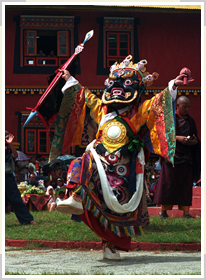
One of the most colourful performances in the world are Sikkim's maskdances,
performed by Lamas in the 'gompa' (monastery) courtyards. The fascinating
dances of Kagyat and the masked Rumtek, and Enchey 'Chaams' (ritual danceof
the lamas), are the popular dances, which recreate legends and myths,
connected with Buddhism, and the eternal triumph of good over evil.
Knotted woollen carpets with the dominating dragon emblem, and eight
auspicious signs; wood carvings, Lepcha handlooms in traditional designsand
rich colours for clothes, bags, linen and accessories; leather jacketsand
handbags, articles of homemade paper, Thanka (religious scroll paintings)
and Sikkimese Dragon Jewellery make a fascinating collection of handicrafts,
inspired by an age old culture.
Sikkim has an estimated 4,000 varieties of flowering plants and shrubs, that
include orchids and the rare rhododendrons that cover the slopes and
mountains. Ornithologists have catalogued 550 species and sub species of
birds, along with 600 varieties of butterflies. Its dense forests aboundwith
endangered species of Himalayan Bear, Musk and Barking Deer, Red Pandaand
Blue Sheep among other fauna.
The capital city of Gangtok, the impressive monasteries of Sikkim,
thetrekker's paradise at Dzongri and the overall raw beauty and grandeur
leave a visitor to this mountain state, with memories to last a life time.
Other places of tourist interest include the Deer Park, Enchey Monastery,
Orchidarium Tashi View Point, Rumtek Monastery and Phodong Monastery.
The economy of Sikkim is basically agrarian. Maize, rice, wheat, potato,
large cardamom, ginger and orange are the principal crops. Ginger, potato,
orange and off season vegetables are the other cash crops. Sikkim is not
industrially developed, but the government has launched a number of
promotional schemes to help the industry. Temi Tea Estate, the only tea
estate in Sikkim with an area of around 400 acres, has earned a reputation
both in domestic and foreign markets, for its superior quality tea. A number
of industrial units have also come up in the state in the area of fruit jams
and juices, bakery products, beer, plastic goods, wrist watches and leather
goods. At the same time, consistent efforts have been made to promote and
preserve traditional arts and crafts, such as wood carving, carpet weaving,
thanka painting, and traditional handlooms. |
|
